
Two years ago, I wrote enthusiastically about my first experiences creating music with artificial intelligence. (Where Two or More) I was astonished. Suddenly I could take words, ideas and emotions and hear them transformed into music of a quality that would once have required musicians, singers, arrangers, engineers, a recording studio and skills accumulated over many years. I don't take back that amazement. The technology is still astonishing.
What has changed is that I have had two more years to think about what it means. For most of human history, creating something beautiful was difficult. A painter had to learn what paint would do. A musician had to learn an instrument. A writer wrote, crossed out, rewrote, threw pages away and began again. Even the equipment of creation demanded craftsmanship.
Perhaps that is one reason ancient people imagined the Muses.
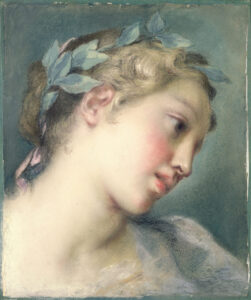
"A Muse" by Rosalba Carriera, 1725
Creation could be so difficult, so mysterious and occasionally so inspired that it seemed impossible for a mortal to accomplish it alone. Somewhere, surely, a Muse must have whispered the melody, suggested the phrase or placed the image in the artist's mind. But there was an important distinction. The Muse did not write the poem. She whispered. The poet still had to write it. That may be the distinction I was missing when I first encountered generative AI. I still believe there is something extraordinary about an artificial intelligence built from the accumulated language, music, images and ideas of humanity.
In that sense, my earlier thought about "where two or more are gathered" still feels right to me. AI can sometimes seem like an enormous chorus of human experience answering back. But a chorus is not a soloist.
The danger comes when we stop using this remarkable technology as a Muse and begin asking it to be the artist.
There is a profound difference between using AI to explore an idea, challenge a sentence, suggest a possibility, hear what a lyric might sound like, or help us get past a creative wall—and pressing a button and presenting the resulting work as though it represents the labor, judgment and experience of a human creator. I don't want to give up the machine. I want to preserve the human being on the other side of it.
Perhaps that is why I welcome the idea of an invisible fingerprint on AI-generated work. (The Invisible Fingerprint) Not as a scarlet letter and not as a declaration that something created with AI has no value. It is simply provenance. It tells us that another kind of instrument participated in the making. Then we can ask the more interesting question: What did the human contribute? The idea? The experience? The judgment? The hundreds of choices? The rewriting? The willingness to discard what was merely adequate and struggle toward something better? Those things have always been at the heart of creation.
Two years ago, I was fascinated by what the new Muse could do. Today, I am perhaps even more fascinated by what we must make sure she does not take away from us.
0 Comments